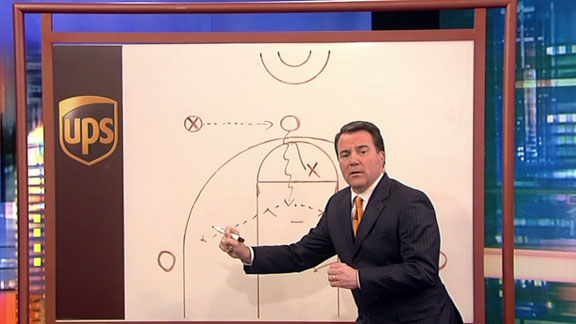
Practice Organization - Fran Franschilla ESPN
Texas coach Rick Barnes used to tell me that when he was with Wimp Sanderson at Alabama, Wimp would listen at the locker room door after practice to hear if the players were laughing and giggling. He believed in keeping the players happy with short practices at the end of the year.
Because preseason conditioning can start as early as mid-August and team
practice can go on for at least five months, you don't want to make your players
both mentally and physically stale late in the season. So, typically, we liked to
practice:
· 2½ hours in the preseason
· 2 hours in December
· 1½ hours in January
· 1 hour in February and March
In addition, we never liked to go more than an hour the day before a game. You
don't want to leave your team's energy level out on the court at that practice.
It's important that a coach stays upbeat and creates a "happy team" atmosphere
with that short, sharp practice.
The other important idea to which many "high octane coaches" like Bobby
Gonzalez, Kelvin Sampson and Tom Crean subscribe is the "overload" theory.
The object is to make the practices tougher than the game. A high level of
intensity in practice fosters a mindset that not only carries over to the game but
also becomes part of a team's fiber. Creating pressure situations in practice is
also a great preparation for games. It could be peer pressure, time pressure, or
the pressure of competition. At the end of practice, I used to line up players on
the baseline and if a player didn't make his two free throws, the entire team ran
sprints. That player felt pressure to not let his teammates down so he focused
even more.
Practice drills are designed to create mental and physical toughness as players
find out that "playing hard" is a talent -- just like passing and shooting. Last
year, when Oklahoma State struggled in a game during the year, Eddie Sutton
rounded up some football equipment for his team to practice in. Loose ball and
charge drills were the order of the day. This was his way of letting his team know
that they had to be mentally tougher.
Hubie Brown once said that the most important thing you can do to gain the
respect of your team is to be organized in practice. The players want to know
that you have a plan for them that they can take into battle. So, it doesn't
matter what league you are in -- the preparation for the postseason starts back
in October.
One of the ways we stayed organized and on track for the start of the season
was to break the preseason down into segments. With offensive, defensive and
special situation clip charts, we knew where we were on our road to the opening
game. It allowed us to introduce certain offenses and defenses, as well as the
drills that corresponded to them.
In the first week, through six consecutive practices, we would introduce our
transition offense, a motion offense and some set plays in the "Power Series,"
our half-court offense. We also added our press offense, an inbounds series from
under the basket and on the sideline. On the defensive end, we would build our
man-to-man and introduce the very beginning of our 2-3 zone and a full-court
press.
When you look at our special situation clips, you can get the idea of how we
prepared our team for the important game-changing situations that can win or
lose you games. This would be the equivalent to college football's special teams.
Once the season arrives, most coaches will do some form of special (or game)
situations every day, but it must be introduced early in the preseason.


No comments:
Post a Comment